Analytical & dense Books

Unpack complex ideas, confront challenging truths, and ponder humanity's fate.

These are the books that demand your full attention, offering a slow, reflective burn through intricate narratives and often bleak landscapes. They delve deep into weighty themes with encyclopedic prose, prioritizing intellectual engagement and existential stakes over fast-paced plots or easy answers. For readers who crave profound introspection and a meticulously crafted, thought-provoking journey. Books in this category are defined by dark and atmospheric and grounded, real-feeling settings, with a steadily paced quality that keeps readers engaged from first page to last.

This list is for readers who know exactly what they want: epic, high-stakes stories with a dark and atmospheric edge, told with steadily paced momentum. If you search for dark atmospheric historical fiction, analytical and reflective, these are the books consistently recommended by readers who've found their niche.

Standout titles include How Democracies Die by Levitsky and Anarchy, State, and Utopia by Nozick. Alongside them you'll find The Rise and Fall of the Great Powers: Economic Change and Military Conflict From 1500 to 2000 by Kennedy, Excellent Sheep by Deresiewicz. All 30 books on this list have been matched to the Analytical & dense archetype by analyzing their pacing, tone, prose style, and worldbuilding — not just genre tags.

30 books
How Democracies Die 📖
1. How Democracies Die
Levitsky, Steven
Mutual tolerance and institutional forbearance are two unwritten democratic norms crucial for a healthy and stable democracy. Coined by Harvard political scientists Steven Levitsky and Daniel Ziblatt in their 2018 book How Democracies Die, they are considered essential "soft guardrails" that reinforce a country's constitutional rules. Mutual tolerance Mutual tolerance is the shared understanding that political rivals are legitimate and loyal citizens with an equal right to exist, compete for power, and govern. It is the willingness of politicians and the public to accept that opponents are not enemies, but legitimate participants in the democratic process. When mutual tolerance erodes, it can create a cycle of distrust where politicians may demonize their opponents and treat political defeat as an existential catastrophe. Examples: A sign of mutual tolerance: A candidate who loses an election publicly concedes and congratulates the winner, even if the results are disappointing. An erosion of mutual tolerance: In the U.S., increasing partisan polarization has led many to perceive the opposing party as an existential threat rather than a legitimate rival. Institutional forbearance Institutional forbearance is the practice of self-restraint in exercising one's legal power. It is the act of not using every legal right to its absolute maximum, in order to preserve the spirit of democratic norms. When politicians practice institutional forbearance, they refrain from engaging in "constitutional hardball," which is the use of legal but norm-violating maneuvers to gain an advantage. Without forbearance, a democracy can descend into severe dysfunction and crisis. Examples: A sign of institutional forbearance: Throughout much of the 20th century, the U.S. Senate generally confirmed a president's qualified judicial nominees in a timely manner, even if they were from the opposing party. An erosion of institutional forbearance: Court packing: While technically legal, a president with a congressional majority expanding the size of the Supreme Court to fill it with political allies would violate the spirit of an independent judiciary. Filibustering: The overuse of the filibuster to obstruct legislation, or a party threatening to shut down the government over policy disputes, breaks the informal norms of institutional restraint. Blocking appointments: The Senate's refusal to even consider President Obama's nomination of Merrick Garland to the Supreme Court in 2016 was a break from a long-standing norm. How they work together Levitsky and Ziblatt argue that these two norms work in tandem to protect democracy. When mutual tolerance erodes and politicians start to see their rivals as threats, they are more likely to abandon institutional forbearance and use their power without restraint. This can lead to an escalating cycle of constitutional hardball and democratic backsliding
political nonfiction political science analytical urgent grave
Pacing
40
Tone
30
World
0
Prose
75
Buy on Amazon Buy on Bookshop
Anarchy, State, and Utopia 📖
2. Anarchy, State, and Utopia
Nozick, Robert
**Anarchy, State, and Utopia** is a 1974 book by the American political philosopher Robert Nozick. It won the 1975 US National Book Award in category Philosophy and Religion, has been translated into 11 languages, and was named one of the "100 most influential books since the war" (1945–1995) by the UK *Times Literary Supplement*. In opposition to *A Theory of Justice* (1971) by John Rawls, and in debate with Michael Walzer,[3] Nozick argues in favor of a minimal state, "limited to the narrow functions of protection against force, theft, fraud, enforcement of contracts, and so on." When a state takes on more responsibilities than these, Nozick argues, rights will be violated. To support the idea of the minimal state, Nozick presents an argument that illustrates how the minimalist state arises naturally from anarchy and how any expansion of state power past this minimalist threshold is unjustified. (Source: [Wikipedia](https://en.wikipedia.org/wiki/Anarchy,_State,_and_Utopia))
philosophical nonfiction political philosophy analytical abstract moralistic
Pacing
10
Tone
20
World
5
Prose
85
Buy on Amazon Buy on Bookshop
The Rise and Fall of the Great Powers: Economic Change and Military Conflict From 1500 to 2000 📖
3. The Rise and Fall of the Great Powers: Economic Change and Military Conflict From 1500 to 2000
Kennedy, Paul M
El eminente historiador Paul Kennedy analiza y describe el auge y la caída de las grandes potencias a lo largo de los últimos cinco siglos. La nación proyecta su poder militar según sus recursos económicos, pero el alto coste de mantener la supremacía militar la precipita a la decadencia. las grandes potencias en crisis reaccionan gastando más en defensa y se debilitan desviando recursos productivos. A lo largo de la historia ha existido una significativa correlación entre las capacidades productivas y la fuerza militar. Una obra esencial para comprender la actual encrucijada mundial.
historical fiction military history analytical detached academic
Pacing
10
Tone
15
World
5
Prose
85
Buy on Amazon Buy on Bookshop
Excellent Sheep 📖
4. Excellent Sheep
Deresiewicz, William
This book is a groundbreaking manifesto about what our nation's top schools should be -- but aren't -- providing: "The ex-Yale professor effectively skewers elite colleges, their brainy but soulless students (those sheep'), pushy parents, and admissions mayhem" (People). As a professor at Yale, William Deresiewicz saw something that troubled him deeply. His students, some of the nation's brightest minds, were adrift when it came to the big questions: how to think critically and creatively and how to find a sense of purpose. Now he argues that elite colleges are turning out conformists without a compass. Excellent Sheep takes a sharp look at the high-pressure conveyor belt that begins with parents and counselors who demand perfect grades and culminates in the skewed applications Deresiewicz saw firsthand as a member of Yale's admissions committee. As schools shift focus from the humanities to "practical" subjects like economics, students are losing the ability to think independently. It is essential, says Deresiewicz, that college be a time for self-discovery, when students can establish their own values and measures of success in order to forge their own paths. He features quotes from real students and graduates he has corresponded with over the years, candidly exposing where the system is broken and offering clear solutions on how to fix it. "Excellent Sheep is likely to make ... a lasting mark. He takes aim at just about the entirety of upper-middle-class life in America. Mr. Deresiewicz's book is packed full of what he wants more of in American life: passionate weirdness" (The New York Times). - Publisher.
literary fiction social critique critical analytical melancholic
Pacing
20
Tone
30
World
5
Prose
85
Buy on Amazon Buy on Bookshop
Genius 📖
5. Genius
Gleick, James
A gem of a book, about the life and mind of one of the most influential and iconoclastic characters in 20th century physics. Really a pleasure to read.
biography scientific biography analytical curious reflective
Pacing
40
Tone
30
World
10
Prose
85
Buy on Amazon Buy on Bookshop
Osman's Dream 📖
6. Osman's Dream
Finkel, Caroline
historical fiction military history analytical detached authoritative
Pacing
20
Tone
25
World
10
Prose
85
Buy on Amazon Buy on Bookshop
The Snowball 📖
7. The Snowball
Schroeder, Alice
Here is THE book recounting the life and times of one of the most respected men in the world, Warren Buffett. The legendary Omaha investor has never written a memoir, but now he has allowed one writer, Alice Schroeder, unprecedented access to explore directly with him and with those closest to him his work, opinions, struggles, triumphs, follies, and wisdom. The result is the personally revealing and complete biography of the man known everywhere as "The Oracle of Omaha."Although the media track him constantly, Buffett himself has never told his full life story. His reality is private, especially by celebrity standards. Indeed, while the homespun persona that the public sees is true as far as it goes, it goes only so far. Warren Buffett is an array of paradoxes. He set out to prove that nice guys can finish first. Over the years he treated his investors as partners, acted as their steward, and championed honesty as an investor, CEO, board member, essayist, and speaker. At the same time he became the world's richest man, all from the modest Omaha headquarters of his company Berkshire Hathaway. None of this fits the term "simple."When Alice Schroeder met Warren Buffett she was an insurance industry analyst and a gifted writer known for her keen perception and business acumen. Her writings on finance impressed him, and as she came to know him she realized that while much had been written on the subject of his investing style, no one had moved beyond that to explore his larger philosophy, which is bound up in a complex personality and the details of his life. Out of this came his decision to cooperate with her on the book about himself that he would never write.Never before has Buffett spent countless hours responding to a writer's questions, talking, giving complete access to his wife, children, friends, and business associates--opening his files, recalling his childhood. It was an act of courage, as The Snowball makes immensely clear. Being human, his own life, like most lives, has been a mix of strengths and frailties. Yet notable though his wealth may be, Buffett's legacy will not be his ranking on the scorecard of wealth; it will be his principles and ideas that have enriched people's lives. This book tells you why Warren Buffett is the most fascinating American success story of our time.From the Hardcover edition.
biography business biography analytical reflective earnest
Pacing
40
Tone
60
World
10
Prose
75
Buy on Amazon Buy on Bookshop
The Broken Kingdoms 📖
8. The Broken Kingdoms
Publications, Locus
"In the city of Shadow, beneath the World Tree, alleyways shimmer with magic and godlings live hidden among mortalkind. Oree Shoth, a blind artist, takes in a strange homeless man on an impulse. This act of kindness ebgulfs Oree in a nightmarish conspiracy. Someone, somehow, is murdering godlings, leaving their desecrated bodies all over the city. And Oree's guest is at the heart of it..."
science fiction speculative fiction anthology analytical encyclopedic professional
Pacing
60
Tone
40
World
70
Prose
45
Buy on Amazon Buy on Bookshop
Towers of midnight 📖
9. Towers of midnight
Publications, Locus
As the seals on the Dark One's prison crumble and the armies of the Shadow boil out of the Blight, Perrin Aybara, hunted by specters from his past, must seek answers in "Tel'aran'rhiod" and find a way to master the wolf within him--or lose himself to it forever. Meanwhile, Matrim Cauthon prepares for the most difficult challenge of his life ... as The Tower of Ghenjei awaits.
science fiction speculative fiction anthology analytical encyclopedic professional
Pacing
60
Tone
40
World
75
Prose
45
Buy on Amazon Buy on Bookshop
Hitchcock: The definitive study of Alfred Hitchcock 📖
10. Hitchcock: The definitive study of Alfred Hitchcock
Truffaut, Francois
The classic study of the great director and his films, comprising a series of dialogues between Hitchcock and Truffaut, is fully updated with material on Hitchcock's last years and his final four films.
literary fiction film criticism / memoir analytical meta reflective
Pacing
40
Tone
30
World
10
Prose
85
Buy on Amazon Buy on Bookshop
The Box 📖
11. The Box
Levinson, Marc
In April 1956, a refitted oil tanker carried fifty-eight shipping containers from Newark to Houston. From that modest beginning, container shipping developed into a huge industry that made the boom in global trade possible. The Box tells the dramatic story of the container's creation, the decade of struggle before it was widely adopted, and the sweeping economic consequences of the sharp fall in transportation costs that containerization brought about. Drawing on previously neglected sources, economist Marc Levinson shows how the container transformed economic geography, devastating traditional ports such as New York and London and fueling the growth of previously obscure ones, such as Oakland. By making shipping so cheap that industry could locate factories far from its customers, the container paved the way for Asia to become the world's workshop and brought consumers a previously unimaginable variety of low-cost products from around the globe.--From publisher description.
historical fiction business history analytical industrial transformative
Pacing
60
Tone
40
World
10
Prose
45
Buy on Amazon Buy on Bookshop
Daughter of Smoke and Bone 📖
12. Daughter of Smoke and Bone
Publications, Locus
Seventeen-year-old Karou, a lovely, enigmatic art student in a Prague boarding school, carries a sketchbook of hideous, frightening monsters--the chimaerae who form the only family she has ever known.
science fiction speculative fiction criticism analytical reflective enthusiastic
Pacing
40
Tone
45
World
70
Prose
65
Buy on Amazon Buy on Bookshop
Walden Two 📖
13. Walden Two
Skinner, B F
This fictional outline of a modern utopia has been a center of controversy ever since its publication in 1948. Set in the United States, it pictures a society in which human problems are solved by a scientific technology of human conduct. It is now widely recognized that great changes must be made in the American way of life. Not only can we not face the rest of the world while consuming and polluting as we do, we cannot for long face ourselves while acknowledging the violence and chaos in which we live. The choice is clear: either we do nothing and allow a miserable and probably catastrophic future to overtake us, or we use our knowledge about human behavior to create a social environment in which we shall live productive and creative lives and do so without jeopardizing the chances that those who follow us will be able to do the same.-Back cover.
science fiction social science fiction didactic utopian analytical
Pacing
40
Tone
60
World
85
Prose
75
Buy on Amazon Buy on Bookshop
JFK & the Unspeakable: Why He Died & Why It Matters 📖
14. JFK & the Unspeakable: Why He Died & Why It Matters
Douglass, James W
In this fascinating and disturbing book James Douglass presents a compelling account of why President John F. Kennedy was assassinated and why the unmasking of this truth remains crucial for the future of our country and the world. Drawing on a vast field of investigation, including many sources available only in recent years, Douglass lays out a sequence of steps by JFK that transformed him, over the course of three years, from a traditional Cold Warrior to someone determined to pull the world back from the edge of apocalypse. Beginning with the fiasco of the Bay of Pigs Invasion (which left him wishing to "splinter the CIA in a thousand pieces"), followed by the Cuban Missile Crisis and his secret back-channel dialogue with Soviet Premier Nikita Khrushchev, JFK pursued a series of actions - right up to the week of his death - that caused members of his own U.S. military-intelligence establishment to regard him as a virtual traitor who had to be eliminated. Far from being ancient history, the story of Kennedy's turn toward peace, and the price this exacted, bears crucial lessons for today. Those who plotted his death were determined not simply to eliminate one man but to kill a vision. Only by unmasking these forces of the "Unspeakable," Douglass argues, can we free ourselves and our country to pursue that vision of peace.
historical fiction political thriller conspiratorial foreboding analytical
Pacing
40
Tone
20
World
10
Prose
85
Buy on Amazon Buy on Bookshop
India's Struggle for Independence 📖
15. India's Struggle for Independence
Chandra, Bipan
historical fiction historical non-fiction analytical documentary solemn
Pacing
20
Tone
40
World
10
Prose
85
Buy on Amazon Buy on Bookshop
In the beginning ...was the command line 📖
16. In the beginning ...was the command line
Stephenson, Neal
This is "the Word" -- one man's word, certainly -- about the art (and artifice) of the state of our computer-centric existence. And considering that the "one man" is Neal Stephenson, "the hacker Hemingway" (Newsweek) -- acclaimed novelist, pragmatist, seer, nerd-friendly philosopher, and nationally bestselling author of groundbreaking literary works (Snow Crash, Cryptonomicon, etc., etc.) -- the word is well worth hearing. Mostly well-reasoned examination and partial rant, Stephenson's In the Beginning...was the Command Line is a thoughtful, irreverent, hilarious treatise on the cyber-culture past and present; on operating system tyrannies and downloaded popular revolutions; on the Internet, Disney World, Big Bangs, not to mention the meaning of life itself.
contemporary fiction nonfiction essay analytical reflective technical
Pacing
40
Tone
60
World
10
Prose
85
Buy on Amazon Buy on Bookshop
Getting the Love You Want, 20th An. Ed. 📖
17. Getting the Love You Want, 20th An. Ed.
Hendrix, Harville
contemporary fiction psychological self-help introspective analytical therapeutic
Pacing
30
Tone
40
World
5
Prose
75
Buy on Amazon Buy on Bookshop
The Difference Engine 📖
18. The Difference Engine
Publications, Locus
<Blockquote> 1855: The Industrial Revolution is in full and inexorable swing, powered by steam-driven cybernetic Engines. Charles Babbage perfects his Analytical Engine and the computer age arrives a century ahead of its time. And three extraordinary characters race toward a rendezvous with history - and the future: Sybil Gerard - dishonored woman and daughter of a Luddite agitator; Edward "Leviathan" Mallory - explorer and paleontologist; Laurence Oliphant - diplomat and spy. Their adventure begins with the discovery of a box of punched Engine cards of unknown origin and purpose. Cards someone wants badly enough to kill for... Part detective story, part historical thriller, The Difference Engine is the first collaborative novel by two of the most brilliant and controversial science fiction authors of our time. Provocative, compelling, intensely imagined, it is a startling extension of Gibson's and Sterling's unique visions - in a new and totally unexpected direction!<Blockquote> -<a href="http://www.goodreads.com/book/show/337116.The_Difference_Engine">Goodreads</a>
science fiction speculative fiction anthology encyclopedic analytical informative
Pacing
85
Tone
45
World
60
Prose
15
Buy on Amazon Buy on Bookshop
Empire of Cotton: A Global History 📖
19. Empire of Cotton: A Global History
Beckert, Sven
The epic story of the rise and fall of the empire of cotton, its centrality in the world economy, and its making and remaking of global capitalism. Sven Beckert's rich, fascinating book tells the story of how, in a remarkably brief period, European entrepreneurs and powerful statesmen recast the world's most significant manufacturing industry combining imperial expansion and slave labor with new machines and wage workers to change the world. Here is the story of how, beginning well before the advent of machine production in 1780, these men created a potent innovation (Beckert calls it war capitalism, capitalism based on unrestrained actions of private individuals; the domination of masters over slaves, of colonial capitalists over indigenous inhabitants), and crucially affected the disparate realms of cotton that had existed for millennia. We see how this thing called war capitalism shaped the rise of cotton, and then was used as a lever to transform the world. The empire of cotton was, from the beginning, a fulcrum of constant global struggle between slaves and planters, merchants and statesmen, farmers and merchants, workers and factory owners. In this as in so many other ways, Beckert makes clear how these forces ushered in the modern world. The result is a book as unsettling and disturbing as it is enlightening: a book that brilliantly weaves together the story of cotton with how the present global world came to exist. - Publisher.
historical fiction economic history analytical grim systemic
Pacing
40
Tone
20
World
95
Prose
85
Buy on Amazon Buy on Bookshop
The Origins of Totalitarianism 📖
20. The Origins of Totalitarianism
ARENDT, Hannah
**Hannah Arendt's definitive work on totalitarianism and an essential component of any study of twentieth-century political history** The Origins of Totalitarianism begins with the rise of anti-Semitism in central and western Europe in the 1800s and continues with an examination of European colonial imperialism from 1884 to the outbreak of World War I. Arendt explores the institutions and operations of totalitarian movements, focusing on the two genuine forms of totalitarian government in her time—Nazi Germany and Stalinist Russia—which she adroitly recognizes were two sides of the same coin, rather than opposing philosophies of Right and Left. From this vantage point, she discusses the evolution of classes into masses, the role of propaganda in dealing with the nontotalitarian world, the use of terror, and the nature of isolation and loneliness as preconditions for total domination.
historical fiction intellectual history analytical bleak academic
Pacing
20
Tone
15
World
10
Prose
85
Buy on Amazon Buy on Bookshop
These Truths: A History of The United States 📖
21. These Truths: A History of The United States
Lepore, Jill
"In the most ambitious one-volume American history in decades, award-winning historian ... Jill Lepore offers a magisterial account of the origins and rise of a divided nation, an urgently needed reckoning with the beauty and tragedy of American history. Written in elegiac prose, Lepore's groundbreaking investigation places truth itself--a devotion to facts, proof, and evidence--at the center of the nation's history. The American experiment rests on three ideas--'these truths, ' Jefferson called them--political equality, natural rights, and the sovereignty of the people. And it rests, too, on a fearless dedication to inquiry, Lepore argues, because self-government depends on it. But has the nation, and democracy itself, delivered on that promise? [This book] tells this uniquely American story, beginning in 1492, asking whether the course of events over more than five centuries has proven the nation's truths, or belied them. To answer that question, Lepore traces the intertwined histories of American politics, law, journalism, and technology, from the colonial town meeting to the nineteenth-century party machine, from talk radio to twenty-first-century Internet polls, from Magna Carta to the Patriot Act, from the printing press to Facebook News. Along the way, Lepore's sovereign chronicle is filled with arresting sketches of both well-known and lesser-known Americans, from a parade of presidents and a rogues' gallery of political mischief makers to the intrepid leaders of protest movements, including Frederick Douglass, the famed abolitionist orator; William Jennings Bryan, the three-time presidential candidate and ultimately tragic populist; Pauli Murray, the visionary civil rights strategist; and Phyllis Schlafly, the uncredited architect of modern conservatism. Americans are descended from slaves and slave owners, from conquerors and the conquered, from immigrants and from people who have fought to end immigration. 'A nation born in contradiction will fight forever over the meaning of its history, ' Lepore writes, but engaging in that struggle by studying the past is part of the work of citizenship. 'The past is an inheritance, a gift and a burden, ' [this book] observes. 'It can't be shirked. 'There's nothing for it but to get to know it'"--Jacket.
historical fiction political history melancholic grave analytical
Pacing
20
Tone
30
World
5
Prose
85
Buy on Amazon Buy on Bookshop
1177 B.C. - Year Civilization Collapsed - Turning Points in Ancient History 📖
22. 1177 B.C. - Year Civilization Collapsed - Turning Points in Ancient History
Cline, Eric H
In 1177 B.C., marauding groups known only as the "Sea Peoples" invaded Egypt. The pharaoh’s army and navy managed to defeat them, but the victory so weakened Egypt that it soon slid into decline, as did most of the surrounding civilizations. After centuries of brilliance, the civilized world of the Bronze Age came to an abrupt and cataclysmic end. Kingdoms fell like dominoes over the course of just a few decades. No more Minoans or Mycenaeans. No more Trojans, Hittites, or Babylonians. The thriving economy and cultures of the late second millennium B.C., which had stretched from Greece to Egypt and Mesopotamia, suddenly ceased to exist, along with writing systems, technology, and monumental architecture. But the Sea Peoples alone could not have caused such widespread breakdown. How did it happen? In this major new account of the causes of this "First Dark Ages," Eric Cline tells the gripping story of how the end was brought about by multiple interconnected failures, ranging from invasion and revolt to earthquakes, drought, and the cutting of international trade routes. Bringing to life the vibrant multicultural world of these great civilizations, he draws a sweeping panorama of the empires and globalized peoples of the Late Bronze Age and shows that it was their very interdependence that hastened their dramatic collapse and ushered in a dark age that lasted centuries. A compelling combination of narrative and the latest scholarship, 1177 B.C. sheds new light on the complex ties that gave rise to, and ultimately destroyed, the flourishing civilizations of the Late Bronze Age -- and that set the stage for the emergence of classical Greece. - Publisher.
historical fiction ancient history scholarly analytical informative
Pacing
40
Tone
60
World
90
Prose
75
Buy on Amazon Buy on Bookshop
Physics of the Impossible: A Scientific Exploration Into the World of Phasers, Force Fields, Teleportation, and Time Travel 📖
23. Physics of the Impossible: A Scientific Exploration Into the World of Phasers, Force Fields, Teleportation, and Time Travel
Kaku, Michio
A fascinating exploration of the science of the impossible—from death rays and force fields to invisibility cloaks—revealing to what extent such technologies might be achievable decades or millennia into the future. One hundred years ago, scientists would have said that lasers, televisions, and the atomic bomb were beyond the realm of physical possibility. In Physics of the Impossible, the renowned physicist Michio Kaku explores to what extent the technologies and devices of science fiction that are deemed equally impossible today might well become commonplace in the future. From teleportation to telekinesis, Kaku uses the world of science fiction to explore the fundamentals—and the limits—of the laws of physics as we know them today. He ranks the impossible technologies by categories—Class I, II, and III, depending on when they might be achieved, within the next century, millennia, or perhaps never. In a compelling and thought-provoking narrative, he explains: - How the science of optics and electromagnetism may one day enable us to bend light around an object, like a stream flowing around a boulder, making the object invisible to observers “downstream” - How ramjet rockets, laser sails, antimatter engines, and nanorockets may one day take us to the nearby stars - How telepathy and psychokinesis, once considered pseudoscience, may one day be possible using advances in MRI, computers, superconductivity, and nanotechnology - Why a time machine is apparently consistent with the known laws of quantum physics, although it would take an unbelievably advanced civilization to actually build one Kaku uses his discussion of each technology as a jumping-off point to explain the science behind it. An extraordinary scientific adventure, Physics of the Impossible takes readers on an unforgettable, mesmerizing journey into the world of science that both enlightens and entertains. [(source)][1] [1]: http://www.amazon.com/Physics-Impossible-Scientific-Exploration-Teleportation/dp/0385520697/ref=dp_return_1?ie=UTF8&n=283155&s=books
science fiction hard science fiction/speculative fiction speculative analytical optimistic
Pacing
40
Tone
60
World
10
Prose
75
Buy on Amazon Buy on Bookshop
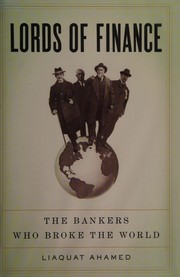
Lords of Finance: The Bankers Who Broke the World 📖
24. Lords of Finance: The Bankers Who Broke the World
Ahamed, Liaquat
With penetrating insights for today, this vital history of the world economic collapse of the late 1920s offers unforgettable portraits of the four men whose personal and professional actions as heads of their respective central banks changed the course of the twentieth centuryIt is commonly believed that the Great Depression that began in 1929 resulted from a confluence of events beyond any one person's or government's control. In fact, as Liaquat Ahamed reveals, it was the decisions taken by a small number of central bankers that were the primary cause of the economic meltdown, the effects of which set the stage for World War II and reverberated for decades.In Lords of Finance, we meet the neurotic and enigmatic Montagu Norman of the Bank of England, the xenophobic and suspicious Emile Moreau of the Banque de France, the arrogant yet brilliant Hjalmar Schacht of the Reichsbank, and Benjamin Strong of the Federal Reserve Bank of New York, whose facade of energy and drive masked a deeply wounded and overburdened man. After the First World War, these central bankers attempted to reconstruct the world of international finance. Despite their differences, they were united by a common fear—that the greatest threat to capitalism was inflation— and by a common vision that the solution was to turn back the clock and return the world to the gold standard.For a brief period in the mid-1920s they appeared to have succeeded. The world's currencies were stabilized and capital began flowing freely across the globe. But beneath the veneer of boom-town prosperity, cracks started to appear in the financial system. The gold standard that all had believed would provide an umbrella of stability proved to be a straitjacket, and the world economy began that terrible downward spiral known as the Great Depression.As yet another period of economic turmoil makes headlines today, the Great Depression and the year 1929 remain the benchmark for true financial mayhem. Offering a new understanding of the global nature of financial crises, Lords of Finance is a potent reminder of the enormous impact that the decisions of central bankers can have, of their fallibility, and of the terrible human consequences that can result when they are wrong.
historical fiction economic history analytical grim documentary
Pacing
40
Tone
30
World
10
Prose
85
Buy on Amazon Buy on Bookshop
A Peace to End All Peace: The Fall of the Ottoman Empire and the Creation of the Modern Middle East 📖
25. A Peace to End All Peace: The Fall of the Ottoman Empire and the Creation of the Modern Middle East
Fromkin, David
How the modern Middle East emerged from decisions made by the Allies during and after World War I.
historical fiction military history analytical grim complex
Pacing
45
Tone
25
World
15
Prose
78
Buy on Amazon Buy on Bookshop
Annihilation of Caste: The Annotated Critical Edition 📖
26. Annihilation of Caste: The Annotated Critical Edition
Ambedkar, B R
"A new annotated critical edition of B.R. Ambedkar's speech "Annihilation of Caste.""--
historical fiction historical nonfiction / political history analytical bleak indictment
Pacing
20
Tone
15
World
5
Prose
85
Buy on Amazon Buy on Bookshop
Empire: The Rise and Demise of the British World Order and the Lessons for Global Power 📖
27. Empire: The Rise and Demise of the British World Order and the Lessons for Global Power
Ferguson, Niall
In this book Niall Ferguson argues that the British Empire should be regarded not merely as vanished Victoriana but as the very cradle of modernity. Nearly all the key features of the twenty-first-century world can be traced back to the extraordinary expansion of Britain's economy, population, and culture from the seventeenth century until the mid-twentieth--economic globalization, the communications revolution, the racial make-up of North America, the notion of humanitarianism, the nature of democracy. Ferguson shows that far from being a subject for nostalgia, the story of the Empire contains. Ferguson shows that far from being a subject for nostalgia, the story of the Empire contains lessons for the world today--in particular for the United States as it stands on the brink of a new kind of imperial power based once again on economic and military supremacy.
historical fiction imperial history analytical grim authoritative
Pacing
40
Tone
20
World
10
Prose
85
Buy on Amazon Buy on Bookshop
Capitalist Realism: Is There No Alternative? 📖
28. Capitalist Realism: Is There No Alternative?
Fisher, Mark
It is easier to imagine the end of the world than the end of capitalism. After 1989, capitalism has successfully presented itself as the only realistic political-economic system - a situation that the bank crisis of 2008, far from ending, actually compounded. The book analyses the development and principal features of this capitalist realism as a lived ideological framework. Using examples from politics, film (Children Of Men, Jason Bourne, Supernanny), fiction (Le Guin and Kafka), work and education, it argues that capitalist realism colours all areas of contemporary experience, is anything but realistic and asks how capitalism and its inconsistencies can be challenged. It is a sharp analysis of the post-ideological malaise that suggests that the economics and politics of free market neo-liberalism are givens rather than constructions.
literary fiction critical theory bleak analytical oppressive
Pacing
20
Tone
15
World
5
Prose
85
Buy on Amazon Buy on Bookshop
The Age of Spiritual Machines 📖
29. The Age of Spiritual Machines
Kurzweil, Ray
Imagine a world where the difference between man and machine blurs, where the line between humanity and technology fades, and where the soul and the silicon chip unite. This is not science fiction. This is the twenty-first century according to Ray Kurzweil, the inventor of the most innovative and compelling technology of our era. In his inspired hands, life in the new millennium no longer seems daunting. Instead, it promises to be an age in which the marriage of human sensitivity and artificial intelligence fundamentally alters and improves the way we live. More than just a list of predictions, Kurzweil's prophetic blueprint for the future guides us through the inexorable advances that will result in: computers exceeding the memory capacity and computational ability of the human brain by the year 2020 (with human-level capabilities not far behind); relationships with automated personalities who will be our teachers, companions, and lovers; and information fed straight into our brains along direct neural pathways. Eventually, the distinction between humans and computers will have become sufficiently blurred that when the machines claim to be conscious, we will believe them. - Back cover.
science fiction speculative nonfiction speculative analytical optimistic
Pacing
90
Tone
60
World
95
Prose
85
Buy on Amazon Buy on Bookshop
Revolutionary Summer: The Birth of American Independence 📖
30. Revolutionary Summer: The Birth of American Independence
Ellis, Joseph J
In this landmark work of history, the National Book Award--winning author of American Sphinx explores how a group of greatly gifted but deeply flawed individuals--Hamilton, Burr, Jefferson, Franklin, Washington, Adams, and Madison--confronted the overwhelming challenges before them to set the course for our nation.The United States was more a fragile hope than a reality in 1790. During the decade that followed, the Founding Fathers--re-examined here as Founding Brothers--combined the ideals of the Declaration of Independence with the content of the Constitution to create the practical workings of our government. Through an analysis of six fascinating episodes--Hamilton and Burr's deadly duel, Washington's precedent-setting Farewell Address, Adams' administration and political partnership with his wife, the debate about where to place the capital, Franklin's attempt to force Congress to confront the issue of slavery and Madison's attempts to block him, and Jefferson and Adams' famous correspondence--Founding Brothers brings to life the vital issues and personalities from the most important decade in our nation's history.From the Trade Paperback edition.
historical fiction political history analytical reflective grave
Pacing
20
Tone
40
World
10
Prose
85
Buy on Amazon Buy on Bookshop